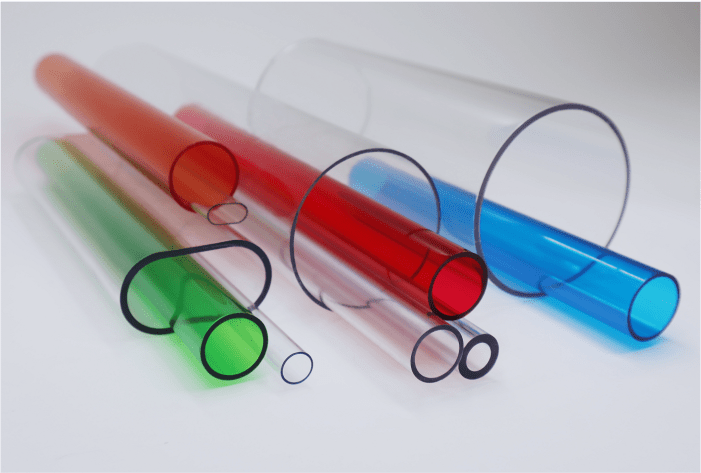
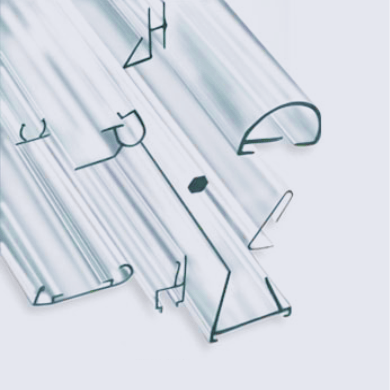
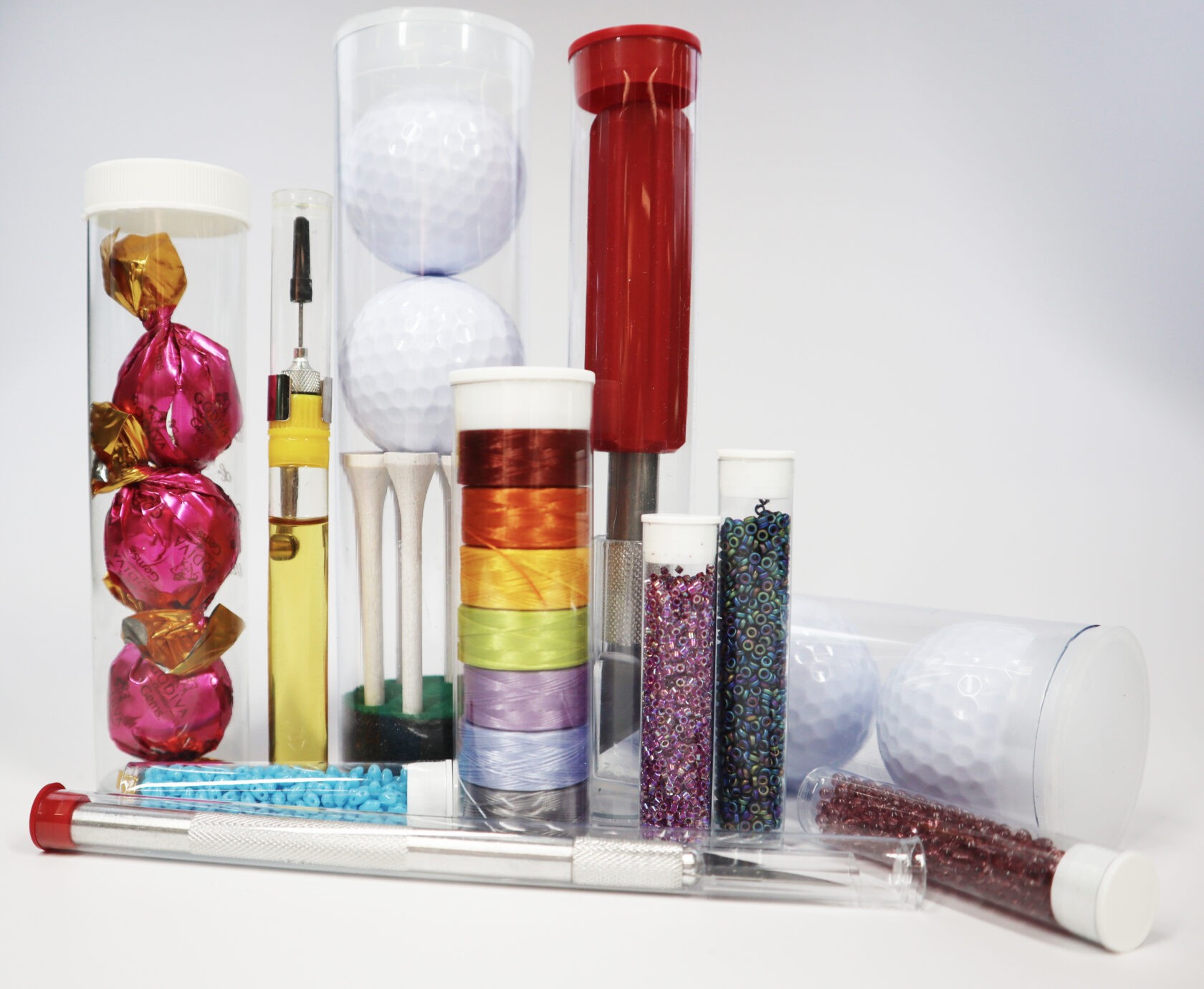
Custom tube manufacturing spans a wide range of manufacturing processes. This guide focuses on plastic extrusion, where material selection, tooling, and dimensional tolerances drive most decisions. If you’re specifying extruded plastic tubing for a packaging, medical, retail, or industrial application, what follows covers what you need to know before requesting a quote.
How Plastic Tube Extrusion Works
Plastic tube extrusion is a continuous process. Resin pellets feed into a heated barrel, where a rotating screw melts and pressurizes the material. The molten plastic is then pushed through a die, a precision-machined tool that determines the tube’s outer diameter, inner diameter, and wall profile. As the tube exits the die, it passes through a sizing sleeve and cooling system, then it is cut to length depending on the application.
In custom tube manufacturing, the die allows a manufacturer to hold tight dimensional tolerances across long production runs. Unlike injection molding, which produces discrete parts in a mold cavity, extrusion produces continuous shapes, making it well-suited for tubing, profiles, and channels.
Material Selection Is the First Decision
The resin you specify determines almost every downstream property of the tube: clarity, chemical resistance, impact strength, temperature range, regulatory compliance, and cost. Most buyers know exactly what material they need based on prior experience, or they know their performance requirements and ask a manufacturer to recommend the right resin. Both are reasonable starting points. In some cases, even if the buyer has a material in mind, the extruder may recommend a different material to reduce costs as long as it maintains functionality.
The three materials most commonly used in clear plastic tube applications are PETG, CAB, and CAP, each with distinct characteristics.
PETG (Polyethylene Terephthalate Glycol) is a glycol-modified copolyester. The glycol modification prevents crystallization during cooling, preserving optical clarity and making the material easier to process than standard PET. PETG exhibits high impact resistance, excellent transparency with light transmission up to 88%, and superior chemical resistance. It is certified under FDA 21 CFR regulations and listed as safe for food contact use. PETG is also available in UV-stable grades for outdoor applications. Typical tube applications for PETG include retail packaging, point-of-purchase displays, medical devices, and food containers.
CAB (Cellulose Acetate Butyrate) is a cellulose-derived thermoplastic. It is amorphous and transparent, with improved weathering resistance and lower moisture absorption compared to standard cellulose acetate, and offers a transparent, glossy surface finish. CAB accepts paint well, which makes it useful in applications where surface decoration matters. CAB tubes are commonly used in soil sampling, pneumatic tube systems, retail packaging, and mailing applications. One limitation worth noting: CAB is degraded by many solvents, including chlorinated and aromatic hydrocarbons, alcohols, and ketones, so chemical compatibility should be verified against the specific contents or environment.
CAP (Cellulose Acetate Propionate) shares the same cellulose-ester family as CAB but substitutes propionyl groups for butyryl groups. This gives CAP a somewhat different property profile, generally better clarity, and a slightly lower moisture absorption than standard cellulose acetate, with good toughness. CAP is used in cosmetics packaging and applications where surface appearance is a primary requirement.
A manufacturer experienced in all three materials can walk you through the tradeoffs once you’ve described your end use. If your application involves chemical exposure, temperature extremes, or regulated contact with food or medical components, inform your extruder up front so they can help you choose a material.
Dimensional Tolerances In Custom Tube Manufacturing
Buyers sometimes submit drawings with tight tolerances on all dimensions when only some require them. This can drive up cost and leads to unnecessary rejections. Others submit drawings with no tolerance at all, leaving the manufacturer to assume, which creates fit problems downstream.
The key dimensions to specify for any extruded tube are outer diameter (OD), inner diameter (ID), wall thickness, and length. In practice, wall thickness tolerance is often the most critical as it affects structural integrity, fit with caps or plugs, and performance in pneumatic or protective applications.
As a general rule, tighter tolerances require more controlled processing conditions and more frequent quality checks, which translates to a higher cost per unit. If your design allows for a wider tolerance band, be sure to include it on drawings or communicate it to the extruder. It gives the manufacturer flexibility that can reduce scrap and improve throughput.
If your tubes need to accept injection-molded caps or plugs, tolerance coordination between the tube and the cap is essential. A mismatch of even a few thousandths of an inch can cause a cap to fail to seat properly or a tube to fail to retain it. Manufacturers who produce both the tubes and the corresponding caps have an inherent advantage here. They can design the tolerance stack across both components.
Application Determines Which Specs Matter Most
Not all custom tube applications give equal weight to the same specifications. Understanding which properties matter most in your application helps you have a productive conversation with a manufacturer and avoid over-specifying things that don’t affect performance.
Retail and point-of-purchase packaging prioritizes optical clarity, surface finish, and consistent OD for cap fit. Wall thickness tolerances are moderate. Color-matching and printability may also be requirements. PETG and CAB both perform well here.
Medical and laboratory applications, including sample collection and component protection, require FDA-compliant materials and tight dimensional tolerances. Documentation of material compliance is often part of the deliverable.
Pneumatic tube systems used in banking, healthcare, and industrial facilities depend on tight OD tolerances and consistent roundness across the length of the tube. A tube that goes out of round in a pneumatic run creates carrier jams. Rigidity and clarity are also valued as operators need to see carrier movement and troubleshoot blockages.
Cosmetic packaging values clarity, surface gloss, and compatibility with the product being displayed, particularly important when the contents include solvents, oils, or alcohol-based formulations. Material compatibility testing against the actual product is worth doing before committing to a full production run.
Mailing and shipping tubes need impact resistance, consistent ID for cap retention, and dimensional stability. Clarity is a differentiator here as a clear plastic tube stands out from a paper mailer and offers better moisture protection.
What to Have Ready Before You Request a Quote
For custom tube manufacturing, providing detailed specifications up front helps ensure the process meets your exact requirements. A manufacturer can generate a quote faster and more accurately when the following is provided:
- Target OD, ID, and wall thickness, with tolerance requirements
- Required length or form factor (cut-to-length, coiled, spooled)
- Material preference, or a description of the performance requirements that drive material selection
- End use and any regulatory requirements
- Estimated annual volume and preferred delivery cadence
- Whether you need matching caps, plugs, or other components
If you’re early in development and don’t have everything yet, be clear about what’s confirmed and what’s still being worked out. A manufacturer with strong engineering support can help you close the gaps, but they need to know where the gaps are.
Custom Tube Manufacturing By Petro Packaging Company Inc.
If you’re specifying custom extruded tubing for a packaging, medical, retail, or industrial application, start the conversation early. Request a quote to review material options and dimensional requirements before finalizing your drawing!